


Menopause Supplements Safe With Medication: A Guide
Table of Contents
- Why Menopause Supplements and Medication Need Careful Checking
- Common Menopause Supplements and HRT Interactions
- Herbal Remedies Interactions With Medication: What to Watch
- How to Check Supplement Ingredients Before You Buy
- Questions to Ask a Pharmacist About Supplements
- Step-by-Step: Consulting Your GP or Pharmacist Safely
- Choosing Menopause Supplements That Fit Your Medication Routine
- Frequently Asked Questions
Last Updated: 20 October 2026
Why Menopause Supplements and Medication Need Careful Checking
Menopause supplements are not automatically safe just because they are sold without a prescription. The same plant compounds that make a supplement useful can also change how your body handles prescribed medicines.
At Zourra, we make supplements for women over 40. We also know that many of our customers take HRT, blood pressure tablets, or thyroid medicine. That combination needs thought, not guesswork.
A common mistake is assuming "natural" means "no interactions." It doesn't. Herbal ingredients can speed up or slow down how your liver breaks down a drug. They can also add to a drug's effect, or cancel it out.
Below, we'll show you exactly how to check any supplement against your medication list, what to ask a pharmacist, and how to build a routine that fits. The steps take about 15 minutes and could save you a difficult conversation with your GP later.
Common Menopause Supplements and HRT Interactions
The most common interaction risk with HRT comes from herbs that affect oestrogen processing, not from vitamins. Vitamins and minerals rarely clash with HRT. Herbal extracts are the ones to watch.
What to Check Before Combining Supplements With HRT
- Which type of HRT you take. Tablets, patches, gels and pessaries are processed differently. Tell the pharmacist which one you use.
- Whether the herb affects the liver. Herbs that change liver enzyme activity can alter HRT levels in your blood.
- Whether the supplement claims to "balance hormones." Vague wording usually hides a herbal blend. Ask for the full ingredient list.
- Your full medication list, including anything bought over the counter. Painkillers, cold remedies and indigestion tablets all count.
If you are unsure, bring the actual packaging to the pharmacy. A pharmacist can read the label faster than you can explain it.
Herbal Remedies Interactions With Medication: What to Watch
Herbal remedies interactions with medication are the area where most problems start. Herbs contain active compounds at doses that can be strong enough to matter.
Herbs That Commonly Affect Prescribed Medicines
- St John's wort. Widely used for low mood. It is known to affect how the body processes several prescribed medicines, including some used in HRT and contraception. If you take any regular medicine, ask before starting it.
- Black cohosh. Popular for hot flushes. Reports of liver effects mean anyone with liver conditions should check first.
- Ginkgo and ginseng. Often taken for focus and energy. Both can affect bleeding and blood pressure medicines.
- Soy and red clover isoflavones. These have mild oestrogen-like activity. That matters if you are on HRT or have a hormone-sensitive condition.
- Valerian and hops. Used for sleep. They can add to the drowsiness caused by other medicines.
How to Check Supplement Ingredients Before You Buy
Checking a label properly takes two minutes and tells you more than any marketing claim. Start with the ingredients list, not the front of the pack.
Work through these checks:
- Find the full ingredients panel. If a brand hides behind a "proprietary blend," you cannot assess it. Skip it.
- Note every herb by its Latin name. The same plant can appear under several names. Latin names remove doubt.
- Check the dose per serving. A herb listed at a tiny dose is unlikely to do much, good or bad.
- Look for a UK supplier address and a batch number. This shows someone is accountable for the product.
- Check for a known interaction list. Reputable brands flag herbs that may interact with medicines.
For general guidance on what supplements should and should not claim, the NHS advice on supplements and vitamins is a sensible starting point.

Questions to Ask a Pharmacist About Supplements
Questions to ask a pharmacist about supplements are simple, and pharmacists expect them. They are trained in interactions and can answer without an appointment.
Ask these, in this order:
- "I take these medicines. Is there anything in this supplement that could interact?"
- "Does this herb affect how my body breaks down my HRT?"
- "Should I take this at a different time from my tablets?"
- "Are there signs I should watch for if something isn't suiting me?"
- "Is there a safer alternative in the same category?"
Write the answers down. Memory is unreliable when you are already managing a lot.
Harmony Complex Hormone Support Supplement →
Step-by-Step: Consulting Your GP or Pharmacist Safely
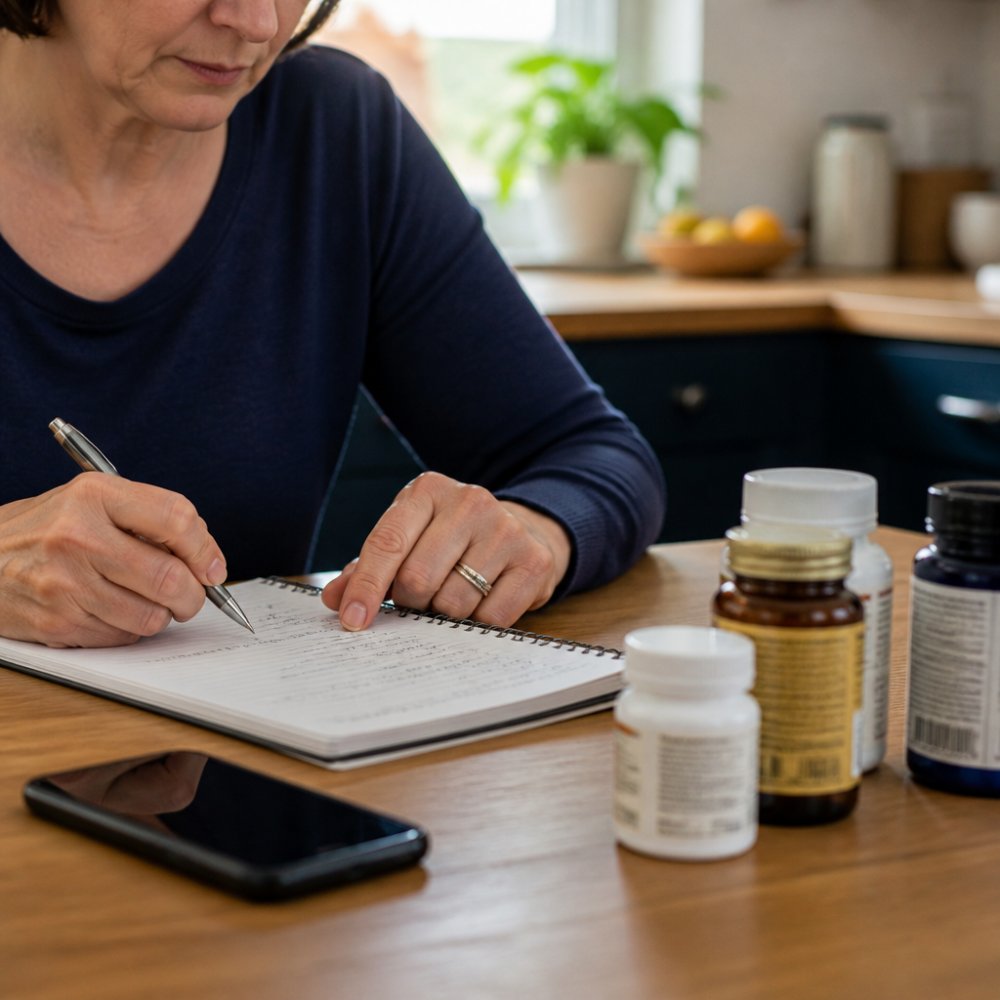
A structured conversation gets better answers. Here is how we would approach it.
Step 1: Book the right appointment. A pharmacist can handle interaction questions on the spot. Book a GP appointment if you have new symptoms, liver problems, or a hormone-sensitive condition.
Step 2: Write your list. Include every medicine, its dose, and how often you take it. Add any supplements you already use.
Step 3: Bring the supplement. Take the actual bottle or a photo of the ingredients panel.
Step 4: Ask your questions. Use the list in the section above. Do not worry about taking up time; this is exactly what they are there for.
Step 5: Record the outcome. Note who you spoke to and what they advised, with the date.
What to Bring and What to Record
| Item | Why it matters | Where to record it |
|---|---|---|
| Full medicine list with doses | Shows the pharmacist exactly what you take | Notebook or phone note |
| Supplement packaging or photo | Gives the exact ingredients and doses | Photo album |
| Any recent blood test results | Relevant for thyroid and liver questions | GP app or printout |
| Date and name of who advised you | Useful if symptoms change later | Same note as your list |
Choosing Menopause Supplements That Fit Your Medication Routine
The safest supplement is the one you can check, time correctly, and explain to your GP in one sentence. Fit matters as much as ingredients.
Practical rules we would follow:
- Keep it simple. Fewer ingredients mean fewer things to check.
- Separate timing where advised. Some minerals are best taken apart from certain medicines. Ask your pharmacist.
- Start one product at a time. If something changes, you know what caused it.
- Re-check after any new prescription. A supplement that was fine last year may not be fine with a new medicine.
Our Harmony Complex is a daily formulation of vitamins and botanicals, made in the UK, with a clear ingredients panel you can take to your pharmacist. Our Magnesium Bisglycinate is non-hormonal and supports normal muscle and nervous system function. Both come from GMP-certified facilities and sit behind a 90-day guarantee, so you can check them with your GP before committing.

Frequently Asked Questions
Can menopause supplements interact with prescription medication?
Yes. Some supplements can affect how your body processes prescribed medicines, and some medicines can affect how well a supplement is absorbed. Herbal ingredients such as St John's wort are known to interact with several medicines, including blood thinners and some antidepressants. Always check the label and speak to a pharmacist before starting any menopause supplement alongside prescription medication.
Should I speak to a pharmacist before taking menopause supplements?
A pharmacist is a good first stop because they can review your full medication list and flag possible interactions. Bring the supplement packaging or a photo of the ingredients panel. Ask specifically about menopause supplements and HRT interactions if you are using hormone therapy, and mention any herbal remedies interactions with medication you already take. This conversation takes minutes and can prevent problems.
Can I take herbal menopause supplements with HRT?
Some herbal remedies can interact with HRT, so check before combining them. For example, St John's wort can reduce the effectiveness of certain medicines, and other herbs may affect how HRT is metabolised. Ask your GP or pharmacist whether a specific herbal supplement is suitable alongside your HRT, and note that how to check supplement ingredients starts with reading the full ingredients list rather than the front label.
Which supplements can affect blood-thinning medication?
Several supplements can affect blood-thinning medicines, including fish oil, high-dose vitamin E, ginkgo, garlic supplements, and ginger in concentrated forms. If you take anticoagulants or antiplatelets, tell your pharmacist about every supplement you use, including menopause products. They can advise whether to avoid a product or adjust monitoring. Never stop or change prescribed medication without medical advice.
Checking your medication list against a new supplement is a small task with a big payoff. If you take prescribed medicine, bring the pack to your pharmacist before you start anything new, and keep a written record of what you take. Zourra makes UK-made, science-backed supplements with full ingredient panels, a 90-day guarantee, and formulas designed for women over 40. Find your formula and start the conversation with your pharmacist today.
